

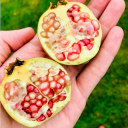
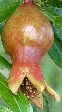
I ordered scions from ucdavis around a decade ago. I lost track of what was what and 1 survived. Of the 6 possibilities does anyone have any input as to which pom of the 6 this could be?
6 possibilities are:
1. Parfianka
2. Al Sirin Nar
3. King
4. Syunt
5. Kazake
6. Sirenevyi
Name that Pom
-
herefiggyfiggy
- Posts: 10
- Joined: Tue Oct 20, 2020 3:44 am
- Location: North County San Diego, Zone 10
Name that Pom
- Attachments
-
- IMG_2333[1].jpg (151.5 KiB) Viewed 8534 times
-
- IMG_2332[1].jpg (192.2 KiB) Viewed 8534 times
-
- IMG_2331[1].jpg (253.71 KiB) Viewed 8534 times
-
- IMG_2329[1].jpg (124.69 KiB) Viewed 8534 times

Re: Name that Pom
Are they ripe now ? Basically, did you just take that picture?
If yes, this is 100% not Sirenevyi.
Also, are the seeds soft or hard?
If yes, this is 100% not Sirenevyi.
Also, are the seeds soft or hard?
USDA z 10a, SoCal, near Los Angeles
-
herefiggyfiggy
- Posts: 10
- Joined: Tue Oct 20, 2020 3:44 am
- Location: North County San Diego, Zone 10
Re: Name that Pom
The pic was taken last weekend. I don't have a ton of experience with Poms bu the seeds I would say are medium hardness. We eat them, so maybe soft to medium. Thanks for the feedback!greenfig wrote: Fri Sep 10, 2021 5:13 pm Are they ripe now ? Basically, did you just take that picture?
If yes, this is 100% not Sirenevyi.
Also, are the seeds soft or hard?
-
herefiggyfiggy
- Posts: 10
- Joined: Tue Oct 20, 2020 3:44 am
- Location: North County San Diego, Zone 10
Re: Name that Pom
Thanks, so it sounsd like I can eliminate Kazake and Sirenevyi from the possibilities.
Re: Name that Pom
At any point in the season did the hull have a yellow color to it before turning dark red? King is described as having dark pink fruit that is very sweet. King is also considered a poor producer (shy number of poms per tree) that is also known for splitting. If yours does not display these characteristics, you can probably cross off King too.
Re: Name that Pom
The Incredible Pomegranate, lists the following information:
- DPUN 136 Syunt – Large sweet fruit and soft seeds. Arils and juice almost white. Insect/disease resistant. (page 56)
- DPUN 136 Syunt – Aril almost white. Excellent. Soft seeded. (page 104)
-
herefiggyfiggy
- Posts: 10
- Joined: Tue Oct 20, 2020 3:44 am
- Location: North County San Diego, Zone 10
Re: Name that Pom
I don't think it had the yellow color, no splitting, and as of now, more on the tart side. That would leave the remaining possibilities as Parfianka orpombazaar wrote: Fri Sep 10, 2021 7:18 pm At any point in the season did the hull have a yellow color to it before turning dark red? King is described as having dark pink fruit that is very sweet. King is also considered a poor producer (shy number of poms per tree) that is also known for splitting. If yours does not display these characteristics, you can probably cross off King too.
Al Sirin Nar. I think i will leave some for a few more weeks and try again to check on the flavor. Now I'm leaning towards Al Sirin Nar.
Re: Name that Pom
My Parfianka has very soft seeds like sunflower kernels. Basically, I never spit them out. The color matches Parfianka but your seeds description do not. If the seeds are not very soft, it still may be a Parfianka...or not.
USDA z 10a, SoCal, near Los Angeles
-
alanmercieca
- Posts: 224
- Joined: Fri Nov 01, 2019 3:59 pm
- Location: North Carolina
Re: Name that Pom
Well basically what he has, has to be one of these two varieties:greenfig wrote: Fri Sep 10, 2021 11:57 pm My Parfianka has very soft seeds like sunflower kernels. Basically, I never spit them out. The color matches Parfianka but your seeds description do not. If the seeds are not very soft, it still may be a Parfianka...or not.
01) Parfianka (is said to have 'very soft edible seeds ')
02) Al Sirin Nar (is said to have 'hard seeds')
His seed description sounds like nether, yet more like Parfianka. One thing that I have learned is that seed softness/hardness of a variety varies, I am guessing based on different climates/micro-climates. I once I had a fruit of a variety that is supposed to have 'very soft seeds', by today's standards 'very soft' might translate to 'soft', because the description of the variety was from the 1920s, regardless the variety's fruit that I ate it had hard seeds. That was not the only variety that I have tried for myself that the seed hardness was different than it was said to be.